

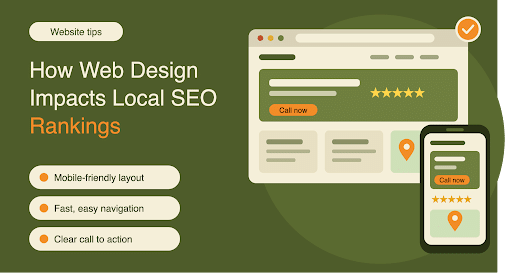
Local SEO is often associated with Google Business Profile optimization, local citations, reviews, and location-based keywords. However, a business website remains one of the most important parts of a local search strategy. Even when a company has strong local signals elsewhere, a poorly designed website can make it harder for search engines and visitors to understand what the business offers and where it operates.
Web design and SEO are not separate concerns. The structure, usability, speed, content presentation, and mobile experience of a website can all influence how effectively a business performs in local search.
Website Structure Helps Search Engines Understand a Business
A well-organized website gives search engines clearer information about the business and its services. Important pages should be easy to find through straightforward navigation, logical page hierarchy, and internal links.
For a local business, this can include dedicated service pages, location pages, contact information, and supporting content. When these elements are organized properly, search engines have an easier time understanding the relationship between the business, its services, and the locations it serves.
Good web design should therefore account for both the visitor’s experience and the way search engines crawl and interpret the website.
Mobile Design Matters for Local Search
A large portion of local searches happen on mobile devices. Someone searching for a plumber, electrician, restaurant, contractor, or other nearby service may be looking for information while away from home.
If a website is difficult to use on a smartphone, visitors may leave before contacting the business. Small text, difficult navigation, slow-loading elements, or buttons that are hard to tap can all create unnecessary friction.
Responsive design allows a website to adapt to different screen sizes while maintaining readable content and usable navigation. This is especially important for local businesses because mobile visitors are often looking for quick answers, directions, service details, or contact options.
Page Speed Can Affect User Experience
Website speed is another area where design and SEO overlap. Heavy images, unnecessary scripts, poorly optimized code, and excessive design elements can increase loading times.
A visitor searching for a local business is unlikely to wait patiently for a page that takes too long to load. A slow experience can increase the likelihood that the visitor returns to search results and chooses another business.
Improving performance does not necessarily mean removing every visual element. Instead, businesses can optimize images, reduce unnecessary scripts, use efficient hosting, and build pages with performance in mind from the beginning.
Clear Navigation Supports Local SEO
Navigation affects both users and search engines. Visitors should be able to quickly understand what a business does and find important information without clicking through several confusing menus.
A local service company, for example, may benefit from navigation that clearly separates its primary services, service areas, about information, and contact details.
Internal linking also helps distribute authority throughout a website and allows search engines to discover related pages. A well-planned structure can connect a main service page with relevant location and supporting content.
Location Information Should Be Easy to Find
Local businesses need to make their geographic relevance clear. A website should provide accurate information about the areas the company serves rather than relying solely on a single mention of a city.
Location information can appear naturally within service pages, contact information, dedicated service-area pages, and other relevant sections. Businesses should avoid creating thin pages that simply replace one city name with another, but genuinely useful location content can help visitors understand whether the company serves their area.
The business name, address, phone number, and other important details should also remain consistent wherever they appear on the site.
Design Can Influence Conversions
SEO brings visitors to a website, but design helps determine what happens after they arrive.
A local business may rank well for an important search term, but that visibility has limited value if visitors cannot figure out how to request a quote, make a booking, call the business, or find the information they need.
Clear calls to action can make a significant difference. Contact buttons, quote forms, phone numbers, appointment options, and service information should be easy to locate without overwhelming the visitor.
The goal is not to fill every section with buttons. Instead, the design should guide visitors naturally toward the next useful action.
E-Commerce Websites Have Additional Considerations
Local businesses that sell products online face another layer of complexity. Their websites need to provide a smooth shopping experience while also making products, categories, business information, and geographic relevance understandable to search engines.
Navigation becomes particularly important as the number of products increases. Categories should be organized logically, product pages should contain useful information, and important pages should not be buried several levels deep.
Businesses that depend on both local visibility and online sales may need specialized ecommerce web design that balances usability, product discovery, performance, and search visibility.
Content and Design Need to Work Together
A visually attractive website cannot compensate for missing or unhelpful content. Search engines need meaningful information to understand the business, while visitors need enough detail to decide whether the company is right for them.
Good design makes that information easier to consume. Headings, short paragraphs, lists, images, FAQs, and well-structured sections can make important information easier to scan.
This is particularly useful for service businesses where visitors may want to understand pricing factors, service processes, coverage areas, qualifications, or common questions before contacting the company.
Technical Elements Should Not Be Overlooked
Some aspects of web design are less visible to visitors but still important for SEO. Proper heading structures, crawlable navigation, descriptive page titles, image optimization, canonicalization, structured data where appropriate, and clean URL structures can all contribute to a technically sound website.
These elements should be considered during the design and development process rather than treated as an afterthought.
A Strong Website Supports the Entire Local SEO Strategy
Local SEO involves much more than adding city names to pages. A business needs a website that communicates what it does, where it operates, and why visitors should consider contacting it.
Effective web design supports this by creating a fast, accessible, mobile-friendly, logically structured website with useful content and clear conversion paths.
For local businesses, the website is often the central point connecting search visibility with real customer actions. When design and SEO are planned together, businesses can create a stronger foundation for attracting local visitors and turning that traffic into inquiries, bookings, and sales.